

11 min read
Most of the cost guides you find online are written for London. They quote figures that make a standard Newcastle bathroom sound like a listed-building restoration, or they hedge so heavily the numbers are useless. If you live in the North East and you are trying to work out what a bathroom renovation actually costs in 2026, this is written for you.
We will walk through the three realistic price bands, what moves you between them, and what the hidden costs are that most quotes do not mention upfront. No filler. Just the numbers and the reasoning behind them.
In short: what does a bathroom renovation cost in the North East in 2026?
In short: budget between £6,000 and £10,000 for a basic refresh, £10,000 to £18,000 for a full mid-range renovation, and £18,000 to £35,000 or more for a premium bathroom with high-spec finishes, reconfiguration, or luxury fixtures. The North East generally sits below London and the South East on labour rates, which helps, but materials, VAT, plumbing complexity, and the age of your property all still have a significant effect on the final number.
Why most bathroom cost guides mislead you
The standard format for a national bathroom cost guide is to quote a wide range, say £3,000 to £20,000, and leave you no clearer than before you started. The range is that wide because it technically covers a cheap cosmetic freshen-up in a small flat and a full wet-room conversion in a detached house. Those are not the same project.
The other problem is that most figures are London-weighted. Labour in the North East is meaningfully cheaper than in the capital, but the guides rarely break this out. You end up thinking a mid-range bathroom should cost £25,000 when, in County Durham or Gateshead, a comparable job can be done for considerably less.
The honest answer is that cost depends on three things above everything else: how much of the layout you change, what materials and fixtures you choose, and what condition your bathroom is in before work starts. Everything else flows from those three decisions.
The three price bands for a North East bathroom renovation
Basic refresh: £6,000 to £10,000
This band covers a like-for-like replacement. You are keeping the toilet, basin, bath, and shower in the same positions, replacing the sanitaryware, updating the taps, repainting or re-tiling with mid-range materials, and fitting new flooring. The plumbing connections stay where they are. Electrical work is limited to swapping out a shaver socket or fan.
It is the right approach if your bathroom layout works and the bones are sound. It is the wrong approach if you have a poorly positioned shower, inadequate ventilation, or hidden water damage that will surface once the walls come off. That last point matters more in older housing stock, which the North East has in quantity.
Full mid-range renovation: £10,000 to £18,000
This is where most full renovation projects land. It covers a complete strip-out, new suite, better tiling including a feature wall or floor pattern, an upgraded shower or bath, and moderate plumbing and electrical work. You might add a heated towel rail, improve the ventilation, or fit a thermostatic shower valve. The layout stays largely the same, but there is room for minor adjustments.
The difference between the lower and upper end of this band usually comes down to tiling choice and fixture quality. Mid-range porcelain and a decent thermostatic shower keep you closer to £12,000. Step up to large-format tiles, a freestanding bath, and concealed plumbing and you are approaching £17,000 or £18,000.
Premium bathroom: £18,000 to £35,000 and above
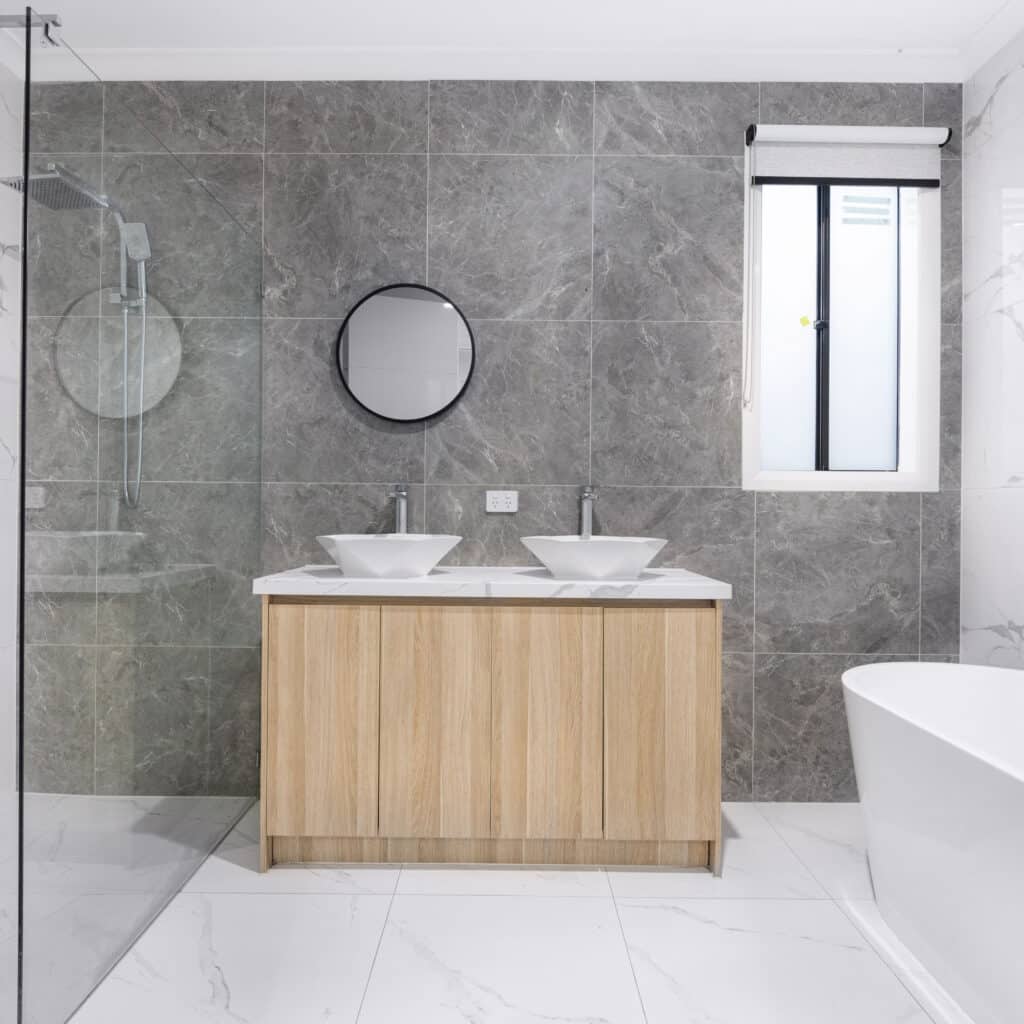
This band is for projects that involve layout reconfiguration, structural changes, or a genuine step up in specification. Wet-room detailing, natural stone tiles, bespoke vanity units, underfloor heating, digital or thermostatic shower systems, niche lighting, stone worktops, and designer brassware all sit here. So does moving a soil pipe, combining two rooms, or reconfiguring a bathroom that was never designed well to begin with.
The upper end of this range is not unusual for a large family bathroom or a principal en suite where the brief is properly high-end. It is not padding. It reflects the cost of premium materials, skilled installation, and the time required to do the job to that standard.
Cost breakdown by budget band
| Budget band | Typical spend (North East 2026) | What it covers |
|---|---|---|
| Basic refresh | £6,000 – £10,000 | Like-for-like suite replacement, mid-range tiles, paint, no layout changes |
| Mid-range renovation | £10,000 – £18,000 | Full strip-out, better tiling, upgraded shower or bath, moderate plumbing and electrical work |
| Premium | £18,000 – £35,000+ | Reconfiguration, natural stone or large-format tiles, wet room, underfloor heating, bespoke joinery, luxury fixtures |
How to split your budget: a working percentage guide
If you have a total budget in mind, this is a reasonable way to think about how it breaks down across the main cost categories. These are not rigid rules, but they give you a sense of proportion before you start getting quotes.
| Cost category | Typical share of total budget |
|---|---|
| Labour and installation | 40% – 55% |
| Tiling and waterproofing | 15% – 25% |
| Suite, taps, shower, and bath | 15% – 25% |
| Electrical, ventilation, and heating | 5% – 15% |
| Contingency | 10% – 15% |
The contingency is not optional. In any room where water has been present for years, there is a reasonable chance of finding something unexpected once the walls come off. Set it aside at the start and do not spend it unless you need it.
What actually pushes the price up
Tiling
Tiling is one of the biggest swing items in any bathroom budget, and it is often the one homeowners underestimate. The material cost alone varies enormously: basic ceramic tiles might cost £15 to £30 per square metre, while large-format porcelain sits at £40 to £80 per square metre and natural stone can reach £100 per square metre or more before you add adhesive, grout, and wastage.
Labour follows the same curve. A straightforward brick-bond pattern on a flat wall is quick. A herringbone floor, a large-format tile requiring precise cutting and levelling, or a feature wall with book-matched stone all take considerably longer and require a higher skill level. Waterproof tanking beneath the tiles, which is essential in a shower enclosure or wet room, adds further cost. Do not treat it as optional.
Plumbing and layout changes
Keeping the soil pipe, toilet, basin, bath, and shower in their existing positions is the single most effective way to control costs. The moment you start moving them, especially the toilet, costs rise sharply. A soil pipe relocation can add £500 to £2,000 to a project depending on access, the run required, and whether the floor needs opening up.
Converting to a wet room also changes the plumbing brief considerably. The floor needs to be tanked and graded to a drain, and that often means a structural assessment if the floor is timber. It is achievable, and the results are excellent, but the cost uplift is real.
Fixtures and brassware
There is a vast range between budget sanitaryware and premium fixtures, and the difference is visible every day you use the room. A basic close-coupled toilet and basin suite can cost £300 to £600. A wall-hung toilet with a concealed cistern and a matching wall-hung basin unit from a quality brand can cost £1,500 to £3,500 for those items alone.
Thermostatic shower valves, freestanding baths, and designer brassware follow the same pattern. A decent thermostatic bar valve costs £150 to £400. A high-end concealed thermostatic system with multiple outlets costs £600 to £2,000 or more. These are genuine quality differences, not just branding. The better valves are easier to clean, more reliable, and feel better to use. Whether they are worth the premium depends entirely on how long you intend to stay in the property and how much you use the room.
Premium finishes
Underfloor heating, niche lighting, high-spec extraction, stone worktops, and bespoke joinery all sit in the premium band and each one adds a meaningful amount to the total. Underfloor heating, for example, typically adds £800 to £2,000 to a bathroom project depending on the room size and whether it is electric or wet-system. It is one of the most requested upgrades and one of the most appreciated once it is in. Bespoke joinery, a vanity unit made to measure for an awkward alcove or a storage unit built around existing pipework, can add £1,500 to £5,000 depending on the specification and finish.
Hidden costs that often get left off early quotes
This is the section that saves arguments at the end of a job. These are the costs that appear after a project starts and that an incomplete early quote will not have included.
- Waterproofing and tanking. Essential in wet areas. Not always included in a first quote, especially from contractors who price the visible work and deal with the rest later.
- Floor levelling. Older properties in the North East, Victorian terraces in particular, often have uneven or damaged floors beneath the existing tiles or vinyl. Levelling compound and preparation add time and cost.
- Water damage or mould behind tiles. You will not know what is behind the walls until the tiles come off. In bathrooms that have had poor ventilation or slow leaks for years, the substrate can be significantly damaged and need replacement before tiling can begin.
- Upgrading dated pipework. Lead or galvanised pipework, which is still present in older North East housing stock, may need replacing once it is exposed. This is not optional: it affects water quality and pressure.
- Ventilation upgrades. Building regulations require adequate mechanical ventilation in bathrooms without openable windows, and often in those with one too. Upgrading from a basic fan to a proper heat-recovery or continuous extraction unit is frequently necessary and not always priced in early.
- Skip hire and waste disposal. A full bathroom strip-out generates significant waste. In a terrace with no drive access or a flat with restricted access, getting that waste out adds both time and cost.
- VAT. All of the figures in this guide are VAT-inclusive where they apply to full renovation work carried out by a VAT-registered contractor. Check this when comparing quotes: a contractor not registered for VAT may quote lower but that is not always the right indicator of overall value.
Why the North East is different
Labour rates in the North East are genuinely more competitive than in London and the South East. The same specification, the same tiles, the same fixtures, will typically cost less to install here than in Surrey or Kensington. That gap has narrowed slightly over recent years as material costs have risen uniformly across the UK, but it remains real and meaningful.
What the North East also has in quantity is older housing stock. Newcastle, Gateshead, Sunderland, Durham, and the surrounding areas have large numbers of Victorian and Edwardian terraces, post-war semis, and older flats where the bathroom has not been touched in twenty or thirty years. These properties carry a higher risk of hidden costs once the renovation starts, and that needs to factor into how much contingency you set aside.
Access can also be a factor. Terraced properties with no rear access or narrow side passages make skip positioning harder. Flats can have restrictions on what can come through communal areas and when. These are not reasons to avoid a renovation, but they are reasons to discuss access and waste removal with any contractor before they price the job, not after.
Planning permission is not normally required for a bathroom renovation unless you are in a listed building or a conservation area, of which the North East has a reasonable number in its historic town centres and rural areas. If your property falls into either category, check with your local authority before the project starts rather than after.
A worked example: a full mid-range bathroom renovation in Newcastle
To make this concrete, here is how a typical mid-range bathroom renovation budget might break down for a standard family bathroom in a semi-detached house in Newcastle in 2026. The bathroom is around five square metres, the layout is staying the same, and the brief is a full strip-out with better tiling, an upgraded suite, and a thermostatic shower.
| Item | Estimated cost (inc. VAT) |
|---|---|
| Labour and installation (strip-out, plumbing, tiling, finishing) | £5,500 – £7,500 |
| Tiling: walls and floor, mid-to-good quality porcelain | £1,800 – £3,000 |
| Waterproof tanking to shower area | £300 – £600 |
| Suite: wall-hung toilet, basin, and vanity unit | £1,200 – £2,200 |
| Thermostatic shower valve and enclosure or screen | £600 – £1,200 |
| Heated towel rail and plumbing connections | £300 – £600 |
| Extraction fan upgrade | £200 – £400 |
| Electrics (lighting, shaver socket, fan) | £400 – £700 |
| Sundries (adhesive, grout, silicone, fixings) | £200 – £400 |
| Contingency (10% – 15%) | £1,050 – £1,660 |
| Total estimated range | £11,550 – £18,260 |
That is a realistic mid-range project. The upper end of that range reflects better tile choices, a slightly higher-spec vanity unit, and a contingency that got used. The lower end reflects smooth progress with no hidden surprises.
How to compare bathroom renovation quotes properly
Getting three quotes is the standard advice, and it is still good advice, but only if you are comparing like for like. Here is what to check before you treat quotes as comparable.
- Is the specification identical? Ask each contractor to price against the same list of fixtures, tiles, and scope. If one has priced a basic close-coupled toilet and another has priced a wall-hung unit, the quotes are not comparable.
- Is VAT included? It should be stated clearly on every quote. If it is not, ask.
- What is the payment schedule? A reasonable schedule ties payments to project milestones: deposit, strip-out complete, first fix complete, tiling complete, snagging and handover. Be cautious about large upfront payment requests.
- What is not included? Ask each contractor to list exclusions explicitly. Common ones are floor preparation, waste disposal, electrical certification, and waterproofing. These are not minor items.
- How do they handle unexpected costs? Ask directly what happens if they open the wall and find water damage or the floor needs levelling. A good contractor will explain their variation process clearly. An evasive answer is information.
- Are they insured and accredited? Verify public liability insurance and check any trade accreditations. For any electrical work, the contractor or a subcontractor needs to be Part P registered.
- Can they provide references for comparable bathroom projects? Specifically bathroom work, not just general building. Ask to see photos of completed bathrooms and, if possible, speak to a previous client.
The lowest quote is not usually the best value. A quote that is significantly lower than the others is often missing something, priced to win the job with variations to follow, or reflecting a lower standard of finish. It is worth understanding why it is lower before you commit.
If you are curious about exactly what a properly structured renovation quote should contain, we are putting together a detailed guide to that shortly. Look out for our upcoming post: Bathroom Renovation Costs: What Is Included in a Proper Quote? It will walk through every line item a thorough quotation should cover and what to do if yours does not.
When you are ready to talk
Hollinside works across Newcastle, Gateshead, Northumberland, and County Durham on residential renovations and extensions. We take a small number of bathroom projects at a time, which means the people who plan and manage your project are the same people who stay across it from start to finish.
If you are at the stage of thinking through your budget and want a straight conversation about what your bathroom renovation is likely to cost and why, get in touch. There is no pressure to proceed and no hard sell. We would rather you go into a project with an accurate picture of the costs and scope than be surprised halfway through.
Last updated: July 2025. All figures are guidance based on current North East market conditions and are not a quotation. Actual costs will depend on your specific property, scope, specification, and site conditions. Obtain written quotes from qualified contractors before committing to any spend.